Let’s Make Happiness Accessible™ Podcast
The Let’s Make Happiness Accessible™ Podcast—a space where we talk about what it truly means to make happiness accessible for the disability community. These are real stories and ideas from disabled individuals, their families, and friends who’ve found creative ways to turn happiness into more than an accommodation—it’s emotional health. I’m Rob Cookenour, deaf with a Cochlear Implant and the creator of the Let’s Make Happiness Accessible™ movement. In each episode, I’ll share small joys I’ve discovered in my own life and spotlight the simple moments that breathe life into those living with accessibility stressors. Because your happiness has always been thought of.
Listen on:








Episodes

Saturday Feb 14, 2026
Saturday Feb 14, 2026
Persistence Without Promise
(A Highlighted Truth from “Still Not Better, Still Beautiful” by Let’s Make Happiness Accessible™)
That’s the reality so many of us in the disabled and chronic illness community quietly live every day. We keep going, showing up, trying again — even when “better” never seems to arrive.
This truth hit home when I heard one creator ask in her video, “Why is better not happening even though we’re working?”That question… stopped me. Because it’s one I think so many of us carry deep down. We put in the effort. We do the exercises. We take the meds. We keep showing up — but progress doesn’t always show up for us.
And yet… we keep going anyway.That’s persistence without promise.And it’s one of the most quietly powerful things about us.
This bonus highlight is a small nod to that strength — and to her question that made me pause and reflect. If her words spoke to you too, go show her some love, because that’s how we build community that sees and honors each other.
You can also see this truth visually through the “Still Not Better, Still Beautiful” shirt drop — not as merch, but as a shared moment of recognition. A way of saying: I feel that too. Shop the Collection
Disabled friends, you’re the best.Let’s Make Happiness Accessible®

Monday Oct 13, 2025
Monday Oct 13, 2025
You did everything expected—and nothing changedby Rob Cookenour “StepDeaf” creator ofLet’s Make Happiness Accessible™
The appointments, the medications, the exercises, the careful tracking of symptoms… all the things we’re told to do, and we do them as expected. And yet, sometimes the progress never comes. Hi let's chat. I'm Rob sharing this emotional truth from the POV of a deaf guy who sees you as hoping someone still cares, hoping someone is listening.
What I see and expressed as a truth is this: Still Not Better, Still Beautiful. That’s a place so many of us in the disabled chronically ill community know well — the endless cycle of showing up, hoping, trying, and leaving with nothing different than before. It’s not failure, it’s not neglect. It’s simply our persistence without promise. You're reading or hearing this while wearing slippers and an oversized top, right? It's like we have casual clothes and appointment clothes; that's it nowadays.
And here’s where my emotional truth comes in: still not better, still beautiful. Because your worth, your dignity, and your beauty aren’t suspended until progress shows up. They’re here right now, in the middle space between hope and exhaustion, in the courage of persistence even when the milestones never arrive. The milestones may never come resulting in frustration, maybe even weariness, but not surrender — but there’s undeniable beauty as is.
After a while, the chaos of it all starts to pile up. X-rays, blood draws, samples, wristbands, hospital gowns — they become part of our vocabulary.
You have your own "A day in the life of . . . ," tailored so unique to your journey. Appointments turn into routines, not breakthroughs. And after another round of “I don’t know if I can help you,” many of us retreat to our safe places: a couch, a pet pressed close, or the comfort of friends who understand without needing explanation. I'll describe friends like this, company that's not trying to fix us.
Let's have an amen to that.
I learned who my friends were after going deaf as a side effect of the Pfizer COVID vaccine in April 2021. 2 Years later in May 2023, I was approved for a Cochlear implant and once activated began to let me navigate parts of the hearing world, but “better” isn’t on the table for me — I live in the reality of different. That’s why still not better, still beautiful isn’t just a phrase I came up with. It’s the lived truth I share with so many disabled friends. Wanna see some pictures? Glad you asked. Here I am the day that my CI was activated smiling with my name tag then me giving a thumbs up as I show my backpack of accessories from Cochlear, both from May 25, 2023 at Vanderbilt in Nashville, TN.
And I’ll be honest: there’s resentment, too. Sometimes it feels like I’m preparing and studying harder for my appointments than the doctors are. Showing up with detailed notes, hoping to be taken seriously, only to leave with another “keep doing what you’re doing.” I actually had an EN&T doctor say, "Beats me," to my question about why have I began to lose balance and equilibrium as further side effects. He still gets paid whether I find comfort in answers or not.
Seems unfair.
That frustration is real — and it’s part of the emotional weight this community carries. Over time, we feel a loss of expectation, expectation of answers that is. We share a mutual “somethings gotta give” emotion after talking about this doctor appointment with no answers, that rehab visit with no improvement, that scan-xray-bodily fluid sample-etc. that simply “took” from us with no helpful results, yet we keep going for “help” without change or help . . . so somethings gotta give, maybe place a wishing well at the entrance of our appointment offices if out of sheer placebo intentions.
I think of Dani (ihatechronicpain), who recently documented her trip to the Mayo Clinic with such thoughtfulness and detail. Her journey showed immense preparation and hope that goes into these appointments. But what struck me most was her follow-up, where she shared the letdown of hearing that, despite all the effort, the treatments might not actually improve her life. That contrast — between careful preparation and crushing disappointment — is an emotional reality so many of us know too well.Watch Dani's Video
Here she is sharing the emotion we all have felt of being told by our doctor that that can't promise that we'll get better.Watch Dani's VideoFor all of us, here’s where the research and lived wisdom meet. Psychologists describe how people adjust to disability through certain shifts:
Enlargement of scope: recognizing values that exist beyond the disability — talents, relationships, passions that remain untouched.
Subordination of the physique: learning not to place all identity in appearance, but to elevate character, humor, or kindness as more defining.
Containment of disability effects: refusing to let a limitation spread across the whole self, naming it for what it actually affects and nothing more.
Transformation from comparative to asset values: moving away from “how do I measure up to them?” into “what unique value do I bring?”
These aren’t just clinical terms — they’re survival strategies we live every day. And they’re proof that even when the medical charts say not better, our lives still hold dignity, depth, and yes, beauty. My deaf disability can’t get better, so I’m different from those that can get better or at least be diagnosed accurately and assistive means added to their lives for easier living.
We'd like to be happy.
That’s why I started Let’s Make Happiness Accessible™ from a momentary pause on the sidewalk of my local post office. That’s where I saw one of the handicap accessible parking signs and stopped to reread it. “Accessible.” Why isn’t happiness something made accessible? A wishful moment of graffiti came to mind as I thought about using a pen to write, “Let’s make happiness,” above the word accessible and walk away with a it as a newfound rallying call for the disabled friends and allies, because our community doesn’t just need to be “handled” or “accommodated.” We need joy. We need dignity. We need to know beauty isn’t canceled out by a diagnosis, or by the absence of progress. Scoot closer so I can show you these two images. The handicap accessible sign with wishful graffiti came from free association sketching in my car while looking at such a sign near me. The other image is little ole me waring it as a first try at capturing the wish as a design for others to think about our happiness, too.
Wishing to be happy or atleast happier has me thinking of voices like Lacey Richcreek, who shares so honestly about cerebral palsy awareness. In one video, she named what so many of us feel in the “why” cycle: “Why the chaos of trying to figure out why, why the anger, why the frustration, why the loneliness, why is better not happening even though we’re working?”Watch Lacey's VideoOr Tayler (known as distaaybled), who describes herself as a DeafDisabledAuDHD girl living with hEDS, endo, and an ostomy. Her words hit hard: “It doesn’t get easier, we just get better at hiding it.” That single sentence captures the exhaustion and invisibility of living in persistence without change.Watch Tayler's VideoCassandra (invisiblestruggless) gave voice to another truth. Sitting on her couch with her cat beside her, she shared: “You handled it so well, when actually I didn’t.” That moment is unforgettable, because it shows how often our safe places — our homes, our pets, our familiar corners — are where the real emotions finally surface.Watch Cassandra's Video
Again, there’s Dani (ihatechronicpain), who shared the words none of us want to hear but too many of us have: “Another doctor whose only answer is, I don’t know if I can help you.”Watch Dani's Video
These creators, and so many others, echo the heart of still not better, still beautiful. Even when progress stalls, your worth doesn’t. Beauty is not on hold until you’re better. It lives in those quiet, ordinary acts of survival: the friend who brings takeout, the pet who curls up after a hard day, the laughter that passes between disabled friends who simply “get it.” You and I "handled it well" cause there was no other option.
Tired of being told that you're an inspiration to someone? Then, you can relate.
“Still Beautiful.” Let’s think about that part of my phrase. There are our allies, friends, family and even pets, who are there for us and find our beauty easy to see. Others see it, too, like our trainers, physical therapy assistants, and those in our schools who all find that watching our daily effort is the beautiful aspect.
Comment with what “still beautiful” means to you to be heard and help others see it another way. After all, still beautiful comes AFTER still not better, meaning what? Is beauty something settled for once appointments and therapies get first priority? Not at all. The beauty is always there because beauty can’t be, “disabled.”
There’s also something else I notice among our community — not in their words, but in the silence between them. What I don’t hear, but deeply sense, is the quiet longing for rest. Not the kind of rest a nap or weekend can fix, but the deeper rest of a body and mind no longer at war with themselves. That unspoken wish is present in the pauses, in the sighs, in the way eyes drop away from the camera. It’s a reminder that exhaustion doesn’t always shout — sometimes it just lingers in the air.
And while we share so much as a community, there’s also this paradox I keep coming back to: we are both mutual and exclusive. Mutual, because we carry the shared identity of disability — we understand each other in ways the able-bodied world often misses. But exclusive, because my deafness is mine to navigate, just as your condition is yours. I can stand beside you in solidarity, but I can’t trade places with you. We are bound together in difference, and that’s part of what makes our community both complex and beautiful. It’s like we’re all at the same concert, but each of us is wearing different noise-canceling headphones. We get the beat, but the songs aren’t the same.
If this message resonated with you, I invite you to explore it further:
You’ll find this and other truths shared as blog posts on my site.
You can also listen to it as an audio podcast episode or watch me — Step-Deaf — share it in a video format.
And if you’d like to carry this message with you, I’ve created apparel featuring “Still Not Better, Still Beautiful” as part of my Let’s Make Happiness Accessible™ collection.
Let’s keep reminding each other: we may not always get better, but we are always enough. Tell me in the comments — what does “still beautiful” mean in your story? Your words would be comfort to those reading and listening to this, a comfort from being heard and listened to.
Still Not Better, Still Beautiful is just one truth. I’ve got more coming — because happiness for the disabled community isn’t optional, it’s essential. That’s why I’ll keep showing up here — on the blog, in the podcast, through video, and yes, even on the T-shirts — to remind us all that joy belongs to us, too, not just accommodations.
That little spark of an idea at a post office sign has grown into this brand — Let’s Make Happiness Accessible™. And I don’t want it to stop at words, podcasts, or apparel. The dream is to grow it into something bigger: a fund to assist disabled people with needs and wishes that often slip through the cracks. Whether it’s helping someone travel to see a specialist, adapt their home, or simply experience a joy they thought was out of reach, I want this brand to be part of making that happen.
Since my voice, my platform, and even my cochlear-implanted ear can help move us toward that, then I’ll keep showing up to say it again and again: still not better, still beautiful.
This isn’t just my story — it’s ours. And it’s not just my brand — it’s Rob building something that could matter to all of us.
Disabled friends, you’re the best.
Explore apparel and accessories featuringStill Not Better, Still Beautiful.Shop the Collection— Created byRob “StepDeaf” Cookenour, founder ofLet’s Make Happiness Accessible™
Tuesday Jul 15, 2025
Tuesday Jul 15, 2025
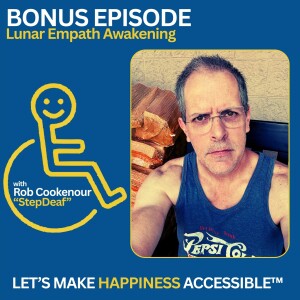
In this special bonus episode of Let’s Make Happiness Accessible™, I sit in a rocking chair outside Lowe’s and reflect on a lifelong pattern I never fully understood—until now. I share how discovering my lunar-geared creativity and empathic flow gave me permission to stop forcing productivity in the sunlight and start honoring how I’m wired. This episode is a raw, voice-recorded moment of breakthrough—recorded right there in the moment, because I had to.
If you’re a night thinker, a late bloomer, or someone who’s always felt “off rhythm” with the world, this one’s for you.
🎧 Recorded in the moment🌙 Embracing empathy + lunar flow📸 Episode image: Me, mid-breakthrough, on a rocking chair outside Lowe’s Home Improvement in Jonesborough, TN.
#LunarEmpath#StepDeaf#Let’sMakeHappinessAccessible#NightOwlCreative#CreativeFlow#EmpathEnergy#AuthenticLiving#SelfDiscoveryJourney#NeurodivergentStrength
Saturday Jul 12, 2025
Saturday Jul 12, 2025
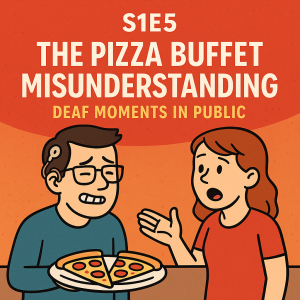
Ever had one of those deaf moments where technology made things worse? In this short episode, I share a funny real-life story that happened at a pizza buffet. I had my cochlear implant and hearing aid set to "streaming focus" mode, enjoying some 80s music while eating alone. But when a staff member started talking to me, I realized too late I couldn't hear a word she said. Just a lot of smiling and nodding while totally guessing. Relatable? You bet.#DeafAwareness #CochlearImplantLife #DeafHumor #AccessibilityMatters #HearingLossJourney #DeafCulture #StreamingFocus #DisabilityStories #LetsMakeHappinessAccessible

Monday Jul 07, 2025
Monday Jul 07, 2025
Welcome back to the Let’s Make Happiness Accessible™ podcast. I’m your host, Step-Deaf, and in this episode, I’m talking about a smart little device that often gets overlooked—the Cochlear Monitor Earphone Adaptor with Earphones, item number Z544578.
This tool allows you or a caregiver to hear what your cochlear processor is picking up, directly through earphones. It’s a great solution for audiologists, teachers, or anyone who needs to check the audio quality without guesswork.
📎 Learn more from Cochlear’s official site:https://www.cochlear.com/us/en/shop/accessories/wireless-accessories/cochlear-monitor-earphone-adaptor-with-earphones/Z544578.html
Whether you’re navigating your own hearing loss or supporting someone who is, this is one accessory that can bring more confidence into your daily communication.
Subscribe for more accessibility tools, honest reviews, and real stories from within the disability community.
#PodcastForTheDeaf #StepDeaf #AccessibilityTech #CochlearImplantTools #LetsMakeHappinessAccessible #HearingLossHelp
Monday Jun 09, 2025
Monday Jun 09, 2025
If you’re disabled, you know what it feels like to be seen only for what you need—not for what you feel.
Yes, ramps matter. Captions matter. Accommodations matter.But what about joy?What about belonging?What about the emotional kind of happiness that doesn’t come from a checklist—but from simply being seen and valued?
I wasn’t born deaf. I lost my hearing overnight after the COVID shot, and suddenly I became “the guy who needed things.” Helpful things, yes—but I started feeling invisible beyond those needs.
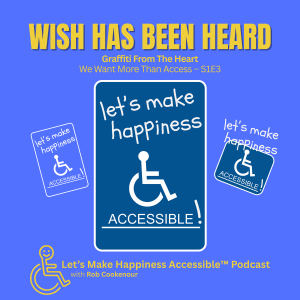
That’s when I looked at an accessibility sign and grabbed a Sharpie. I scrawled the words: “Let’s Make Happiness Accessible!”That graffiti moment became the spark that started this entire brand.
This episode is about that spark—and why this message goes deeper than products or slogans. It’s about the quiet truth no one says out loud: Disabled people want happiness, too. Not just support. Not just inclusion. Joy. Contentment. Recognition.
If you’ve ever wished someone understood the emotional side of disability—what it’s like to feel both strong and overlooked—this episode is for you.
You're not wrong for wanting more than just access.
Let’s make happiness accessible—together.
#LetsMakeHappinessAccessible
#StepDeaf
Monday Jun 09, 2025
Monday Jun 09, 2025
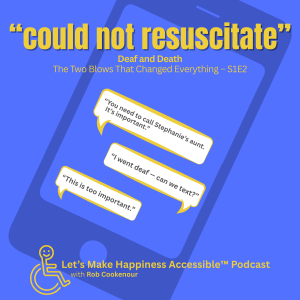
In this deeply personal episode, I share the two life-altering events that collided within two years — the sudden loss of my hearing in 2021, and the death of my daughter, Stephanie, in early 2023.
I open up about the chaos of going deaf, the emotional and financial toll, and the silence that settled over my world just as I was beginning to navigate life again. Then came the message that changed everything — a stranger on Facebook, a borrowed phone call, and the words no parent ever wants to read.
This is a story of grief, deafness, and love that endures even in absence. It’s about showing up for a final goodbye. About making space for birthdays even when the guest of honor is gone. And about finding ways to keep joy alive — not just for me, but for those still here.
Because even in silence, love has a voice.And even in grief, happiness deserves to be accessible.
#LetsMakeHappinessAccessible
#StepDeaf
Monday Jun 09, 2025
Monday Jun 09, 2025
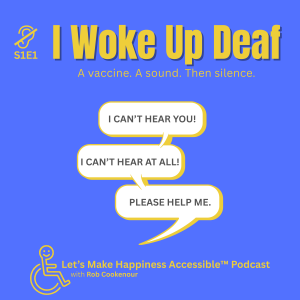
What would you do if you woke up one morning and the world had gone silent?
In this gripping first episode of Let’s Make Happiness Accessible™ Podcast, I share the raw, unfiltered story of the day I lost my hearing — just days after receiving the Pfizer COVID vaccine. From confusion to crisis, from holding out my phone for voice-to-text conversations with strangers to eventually receiving a cochlear implant, this episode captures the surreal moment when everything changed.
It’s not political — it’s personal. And it’s just the beginning.
🎧 Tune in if you’ve ever faced a life-altering change and wondered, “What now?”
#LetsMakeHappinessAccessible
#StepDeaf